図形の中のベクトルを2つのベクトルで表す(A)
★☆☆☆☆☆☆(教科書) / 作成者: shonan / 2026/10/27
🔁 類題: 図形の中のベクトルを2つのベクトルで表す(B) (★☆☆☆☆☆☆(教科書))
問題
正六角形 $\mathrm{ABCDEF}$ において,$\overrightarrow{\mathrm{AB}}=\vec{a}$,$\overrightarrow{\mathrm{AF}}=\vec{b}$ とする.次のベクトルを $\vec{a}$,$\vec{b}$ で表せ.
\begin{enumerate}
\item[(1)] $\overrightarrow{\mathrm{AD}}$
\item[(2)] $\overrightarrow{\mathrm{BC}}$
\item[(3)] $\overrightarrow{\mathrm{CE}}$
\item[(4)] $\overrightarrow{\mathrm{BF}}$
\end{enumerate}
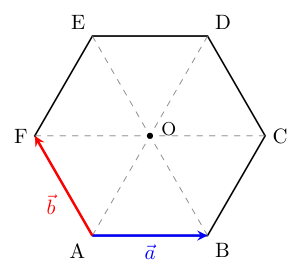
正六角形の中心を $\mathrm{O}$ とすると,$\triangle\mathrm{OAB}$,$\triangle\mathrm{OAF}$ などは正三角形で,四角形 $\mathrm{ABOF}$ はひし形である.よって
\[ \overrightarrow{\mathrm{AO}}=\overrightarrow{\mathrm{AB}}+\overrightarrow{\mathrm{AF}}=\vec{a}+\vec{b} \]
(1) $\overrightarrow{\mathrm{AD}}=2\overrightarrow{\mathrm{AO}}=2\vec{a}+2\vec{b}$
(2) $\overrightarrow{\mathrm{BC}}=\overrightarrow{\mathrm{AO}}=\vec{a}+\vec{b}$
(3) $\overrightarrow{\mathrm{CE}}=\overrightarrow{\mathrm{CD}}+\overrightarrow{\mathrm{DE}}$ で,$\overrightarrow{\mathrm{CD}}=\overrightarrow{\mathrm{AF}}=\vec{b}$,$\overrightarrow{\mathrm{DE}}=-\overrightarrow{\mathrm{AB}}=-\vec{a}$ であるから
\[ \overrightarrow{\mathrm{CE}}=-\vec{a}+\vec{b} \]
(4) $\overrightarrow{\mathrm{BF}}=\overrightarrow{\mathrm{AF}}-\overrightarrow{\mathrm{AB}}=-\vec{a}+\vec{b}$
⭐ お気に入り 0
ログインするとお気に入り・印刷リスト・PDF出力が使えます